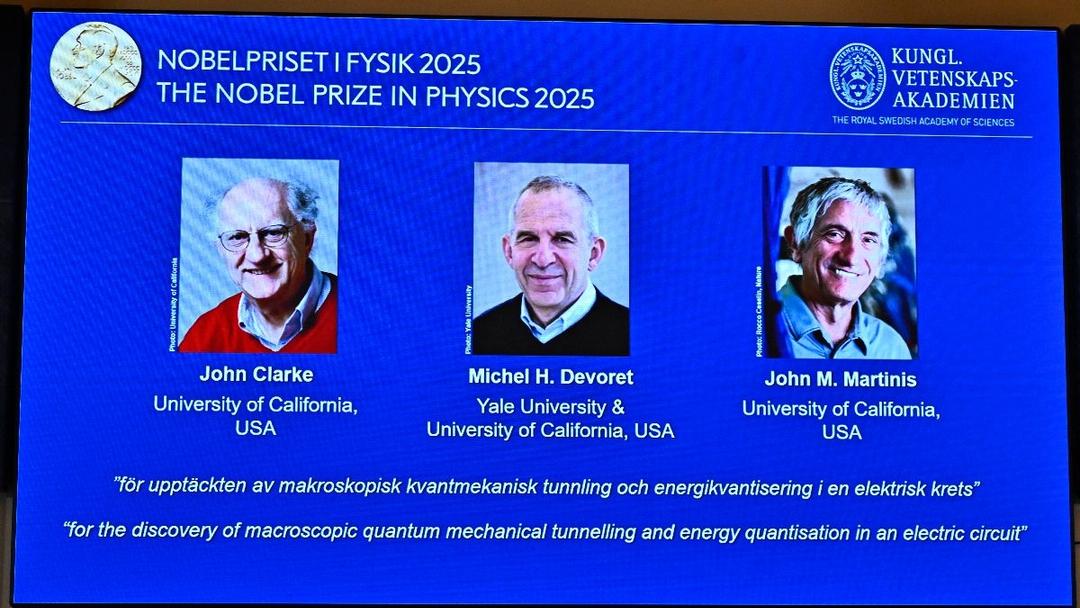
Three Scientists Win 2025 Nobel Prize for Quantum Discovery
Three Scientists Win 2025 Nobel Physics Prize for Quantum Discovery
The Spin
The 2025 Nobel Prize in Physics representsis a monumental breakthrough that bridges the gap between quantum mechanics withand the tangible world. Clarke, Devoret and Martinis proved that quantum effects can operate on macroscopic scales through Josephson junctions. This foundational 1985 work directly enables today's quantum computing revolution and advances in cryptography advances.
Quantum computing remains plagued by controversy and overhype despite decades of promises. Microsoft's disputed claims about topological qubits show researchers can't even agree on basic results. The technology won't deliver usefulpractical applications for at least another decade, risking a quantum winter when disappointed investors flee.
Metaculus Prediction
There's a 30% chance that a Russian will win a Nobel Prize in Physics before 2035, according to the Metaculus prediction community.
© 2026 Improve the News Foundation.
All rights reserved.
Version 7.4.1